


The value of playing with what we had at hand
Before screens and video games, the street was our best playground. We didn't need anything big: a rope, some bottle caps, a flat rock, or just a group of friends. We played until the streetlights came on or until someone called our name from the balcony. That was childhood in Spain: free, bustling, and filled with afternoons that stretched on endlessly.
There were fewer cars, a greater sense of security, and less fear. And that changed everything. We played without adult supervision, with a freedom that now seems unthinkable. Not because it was a different world, but because we lived with less awareness of danger. And that made us fly.
Popular games that marked an era
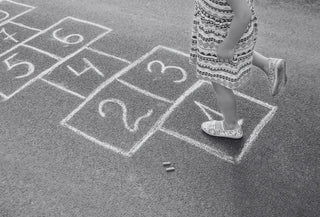
1. Hopscotch
A stone and a piece of chalk (or a stick for drawing in the dirt) were enough. You had to have good aim and balance, and turns were respected with an almost solemn seriousness. Hopscotch, with its numbered squares, was a small daily challenge.
2. The marbles
Whoever had a good glass marble was king of the playground. We played in the dirt, digging holes and throwing skillfully. And if they got lost, oh boy... that's when things got really bad.

3. The jump rope and the elastic
Especially popular with the girls, although we all joined in. Jumping to the rhythm of songs, challenges, and laughter. Rope skipping was pure cooperation: some twirled, others jumped, and everyone sang.
4. Hide and seek and 1-2-3 English hide and seek (or "English chicken")
One of the absolute kings of summer. Nothing beats running, hiding, and holding back laughter while the person counting said, "For me, for all my friends, and for me first." And at night, the game changed its name: English hide-and-seek, or as we used to say in Seville, "English chick." We don't know where the name came from, but we loved it.
5. Ball games
On the wall, in a circle, with or without bounces. The ball was almost always the protagonist. In courtyards, squares, or alleys, any corner served as a place to invent a game. And if you had to stop because a car was coming, you stopped. And then you continued.

6. The bottle cap game
A mix of racing, skill, and collecting . Everyone brought their own gear (some badges decorated with paper and tape), and they organized authentic Tour de France championships on the cobblestones or sand of the park.

7. The spinning top
Spinning a top was an art form. At first, it wouldn't work. It fell, bounced, rolled sideways. But when you finally got it to spin steadily, centered, as if hypnotized... what a pride! You had to know how to wind the string properly, and throw with strength and style. In many towns, competitions were even held in the town square.

8. The potato ring
"In the potato ring, we'll eat salad..." Who doesn't remember that song? A classic group game, where hands clasped and bodies twirled to the rhythm of lyrics that still resonate in our memories today. The potato ring was pure childhood: togetherness, singing, and laughter guaranteed.
Cutouts: The magic of playing on rainy days
It wasn't all about running around. There were rainy afternoons, days when the ground was wet, or simply moments of calm. And that's where the paper dolls came in. Oh, how wonderful! The paper dolls with their dresses, their accessories, and that little box where we carefully stored everything. Cutting was one of those tasks that required patience, concentration, and care. Sometimes an arm would break, or the cap's tab wouldn't fit properly. But that didn't take away a bit of the magic.

Learning while playing
It wasn't just a matter of entertainment. Traditional Spanish games taught us rules, patience, strategy, and teamwork. Without realizing it, we learned to wait our turn, lose gracefully, and win humbly.
Many games required repetition, persistence, making mistakes, and trying again. Like the top , which kept falling at first. Or the marbles , which seemed impossible to get right. But you had to keep at it. No instant rewards, no congratulatory screens. Just the pride of having succeeded.

Memory boxes and games to share
At Real Fábrica, we like to keep these traditions alive. That's why we have traditional games in our online and physical stores: spinning tops , yo-yos , bottle caps , Saint Isido whistles , and the game of knucklebones. We also have books like Juegos de Antaño todo el año (Year-Round Games ), which lovingly captures a wealth of games from our childhood.
And of course, the paper toys, which continue to bring smiles to children and adults alike. Because yes, there's still time to recapture those quiet moments of paper and scissors.
We invite everyone who wants to play again like they used to, to recapture that little piece of shared childhood that made us so happy. Because returning to those games is, ultimately, coming home.
_________________________
 Real Fábrica is a project born to reclaim what's ours: what's well-made, what has history and soul. We travel across Spain in search of traditional products, those that smell of childhood, of the village, of long after-dinner conversations. You can discover our pieces in the online store , read the stories we tell on the blog , and join our community by subscribing to the newsletter .